
Why Every BBA Student Should Understand Economics Early
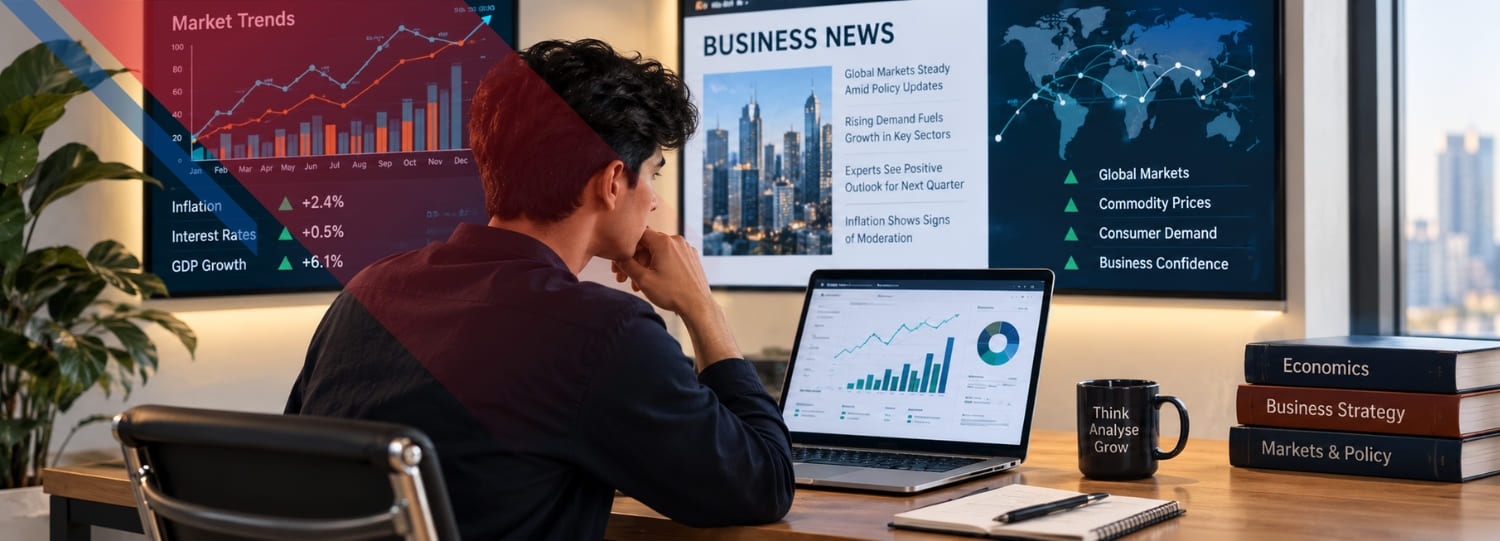
A young management graduate entering the workplace often discovers very quickly that business decisions are rarely made in isolation. A sales target may change because consumer demand has weakened. A hiring plan may be postponed because borrowing costs have risen. A marketing campaign may need revision because inflation has affected household spending. A start-up may delay expansion because investors have become cautious. These are not only business issues; they are economic signals.
This is why economics should not be treated by BBA students as a first-year subject to be completed and forgotten. It is one of the foundational disciplines that helps students understand why businesses behave the way they do, why markets shift, and why managers must constantly make decisions under constraint. For a student beginning a business education, economics provides an early lens through which the world of management becomes more coherent.
Why Economics Matters at the Beginning of Business Education
Many students enter a BBA programme with a natural interest in marketing, finance, entrepreneurship, human resources, or analytics. Economics may initially appear more abstract than these applied areas. Yet the reality is that every business function depends on economic conditions.
A marketing manager must understand purchasing power and consumer confidence. A finance professional must understand interest rates, inflation, liquidity, and risk. A human resources leader must understand labour markets, productivity, wages, and employability. An entrepreneur must understand demand, pricing, scarcity, competition, and capital allocation. Even a product manager must read market signals before deciding what to build, when to launch, and how to price.
When students learn economics early, they begin to connect classroom concepts with everyday business news. They understand that inflation is not merely a number announced in the media; it affects consumer behaviour, cost structures, wage expectations, and business margins. Interest rates are not only a banking topic; they influence loans, investments, real estate demand, consumer durable purchases, and corporate expansion. Policy decisions are not distant government actions; they can change the attractiveness of sectors, the cost of doing business, and the confidence of investors.
This early understanding helps students move from awareness to interpretation.
The Common Misconception: Economics Is Only Theory
A frequent misconception among undergraduate students is that economics is theoretical, mathematical, or distant from managerial practice. This view usually changes when students begin internships or corporate roles. They realize that business leaders constantly deal with economic questions, even when they do not use formal economic terminology.
Should the company increase prices or absorb rising input costs? Should it expand now or wait for better demand conditions? Should it enter a price-sensitive market or focus on a premium segment? Should it hire aggressively or improve productivity with the existing workforce? Should a firm invest in automation when labour costs are rising?
Each of these decisions involves economic reasoning. They involve scarcity, trade-offs, incentives, opportunity cost, demand elasticity, competition, and risk. Economics gives students a disciplined way to think through these questions.
The Academic Lens: Demand, Supply, Opportunity Cost, and Equilibrium
The value of economics begins with simple but powerful concepts. Demand and supply teach students that markets are shaped by the interaction between buyers, sellers, prices, preferences, income, and availability. A product does not succeed only because it is well designed. It succeeds when it meets a real demand at a price the market can accept.
Opportunity cost is equally important. In business, every choice has an alternative cost. Investing in one project may mean postponing another. Spending more on advertising may reduce funds available for product development. Expanding into a new market may require accepting lower short-term profitability. Students who understand opportunity cost become more realistic decision-makers because they learn that management is not about choosing between good and bad options, but often between competing priorities.
Market equilibrium helps students understand that business conditions are dynamic. Prices, demand, supply, and competition continuously adjust to new information. A policy change, a competitor’s move, a supply chain disruption, or a shift in consumer preference can alter the balance of a market. This is why business plans cannot be static. Managers must keep reading the environment.
Microeconomics helps students understand firms, consumers, pricing, competition, and resource allocation. Macroeconomics expands this lens to the larger economy through inflation, GDP growth, employment, monetary policy, fiscal policy, exchange rates, and global cycles. Together, they help students understand both the firm and the environment in which the firm operates.
How Economic Thinking Plays Out in Organizations
In organizations, economic awareness often separates mechanical execution from informed judgement. Consider a retail business facing rising input costs. A manager without economic understanding may see only a margin problem. A manager with economic understanding will ask deeper questions: How price-sensitive are our customers? Can we pass on the cost increase? Will competitors raise prices too? Can we redesign the product mix? Can supply contracts be renegotiated? Will consumer demand weaken if inflation persists?
Similarly, in a technology company, a slowdown in global demand may affect hiring, client budgets, and project pipelines. Students who understand business cycles are better prepared to interpret such developments without panic or oversimplification. They recognize that companies often expand during growth phases and become more efficiency-focused during uncertain periods.
In finance, the connection is even more direct. Interest rates influence borrowing costs, investment decisions, valuations, and consumer loans. A BBA student who understands monetary policy will be able to read financial news with greater depth. They will not simply know that rates have changed; they will understand why it matters.
Practical Implications for BBA Students
The first practical step for students is to read economic news regularly, but with a questioning mind. The objective is not to memorize every number. It is to understand relationships. When inflation rises, what happens to consumers? When interest rates change, what happens to loans and investment? When the government announces infrastructure spending, which sectors may benefit? When global demand slows, how might export-oriented industries respond?
The second step is to connect economics with business functions. Students should ask how each economic event affects marketing, finance, operations, human resources, and entrepreneurship. This habit builds interdisciplinary thinking, which is essential for management careers.
The third step is to interpret business cycles. Growth, slowdown, recovery, and uncertainty are normal features of economic life. Students who understand these cycles are better prepared for workplace realities. They can evaluate career opportunities, organizational decisions, and industry trends with greater maturity.
The fourth step is to use economics as a decision-making tool. Whether a student is preparing for an internship, a case discussion, a business plan competition, or a job interview, economic awareness improves the quality of analysis. It helps students explain not only what a company is doing, but why it may be doing it.
Why Economic Literacy Will Matter More in the Future
The future workplace will demand graduates who can combine functional knowledge with broader judgement. Reports on future skills consistently emphasize analytical thinking, adaptability, and the ability to understand complex systems. Economic literacy contributes directly to these capabilities because it trains students to examine cause and effect, incentives, constraints, trade-offs, and unintended consequences.
For India’s young management graduates, this is especially relevant. The country is operating in a period of rapid digital transformation, infrastructure development, policy reform, changing labour markets, and global economic uncertainty. Students who can understand these shifts will be better prepared to work across sectors such as technology, banking, consulting, consumer goods, logistics, manufacturing, education, and entrepreneurship.
Economics does not make decision-making easy. It does something more valuable: it makes decision-making clearer. It teaches students to look beyond headlines, question assumptions, and understand the forces shaping business outcomes.
For a BBA student, learning economics early is therefore not an academic formality. It is a professional advantage. It builds the habit of thinking like a manager before formally becoming one.
References / Sources Used
- World Economic Forum, Future of Jobs Report 2023.
- Reserve Bank of India, Monetary Policy publications and updates.
- World Bank, India Development Update.
- NASSCOM, Technology Sector in India: Strategic Review 2025.
- Harvard Business Review, Business Education and Management Insights.