The Promotion Question Few Professionals Fully Understand
In most organizations, there comes a point when strong performance is no longer enough to explain career movement. Two professionals may both deliver results, meet deadlines, and be respected by their teams. Yet one is gradually invited into larger conversations, given ambiguous assignments, exposed to senior stakeholders, and considered for leadership roles. The other remains a dependable performer but does not move significantly beyond the current scope.
This difference is often misunderstood. Professionals may assume that senior leaders notice only visible effort, long working hours, technical brilliance, or aggressive confidence. These qualities may attract attention, but they do not automatically create leadership trust. At higher levels, the central question changes. Senior leadership is not simply asking, “Who is working hard?” or “Who delivered the last target?” It is asking, “Who can be trusted with larger responsibility when the situation is uncertain, interdependent, and consequential?”
That question has become particularly important in contemporary workplaces. Organizations are dealing with technological disruption, artificial intelligence, hybrid teams, margin pressure, regulatory scrutiny, and shifting employee expectations. The World Economic Forum’s Future of Jobs Report 2025 identifies analytical thinking, resilience, flexibility, agility, leadership, and social influence among the most important capabilities for the future workforce. LinkedIn’s Workplace Learning Report 2025 similarly emphasizes the growing importance of career development, learning agility, and leadership capability as organizations try to close critical skills gaps.
For students, early-career professionals, MBA aspirants, and managers, the implication is clear. Career growth is not merely a reward for past performance. It is a judgment about future readiness.
The Misconception: Good Performance Automatically Signals Leadership Potential
One of the most persistent misconceptions in professional life is that the best individual performer should naturally become the next leader. This belief appears logical. If someone is excellent at a role, why should they not be promoted to manage others in that area?
The difficulty is that performance and potential are related but not identical. Performance measures how well a person succeeds in the current role. Potential asks whether the person can succeed in a larger, less defined, and more complex role. The first depends heavily on task competence. The second requires judgment, influence, emotional maturity, ownership, and the ability to work across systems.
An excellent analyst may not automatically become an effective team leader. A high-performing salesperson may not necessarily become a strong regional manager. A technically skilled project manager may struggle when asked to influence finance, technology, operations, and customer-facing teams at the same time. The capabilities that make someone effective as an individual contributor do not always translate directly into leadership effectiveness.
This is why senior leaders are cautious when evaluating readiness for bigger roles. They do not ignore performance. In fact, consistent performance is usually the entry ticket. But once performance is established, they begin to look for deeper signals. Does the person create clarity or add confusion? Can they handle disagreement without becoming defensive? Do they understand the commercial consequences of their work? Can they be trusted when no one is watching closely? Do they think only about their function, or do they understand the enterprise?
Harvard Business Publishing’s work on high-potential talent makes a similar distinction. It suggests that leadership potential cannot be judged only by past results. Organizations must also look at cognitive capability, drive, emotional capability, and the ability to grow into responsibilities not yet experienced. This is an important point for professionals: senior leadership is not only evaluating what one has done. It is assessing what one may be capable of doing next.
A Management Lens: From Human Capital to Enterprise Capability
A useful way to understand this shift is through the lens of human capital. Human capital refers to the knowledge, skills, experience, and capabilities that allow individuals to create value. In the early stages of a career, human capital is often assessed through education, technical skills, discipline, and task execution. These are important foundations. Without them, credibility is difficult to build.
However, as professionals move upward, the nature of valuable human capital changes. The organization no longer needs only someone who can complete assigned work efficiently. It needs someone who can interpret problems, connect decisions to business priorities, align people, manage trade-offs, and act responsibly under ambiguity.
Leadership, therefore, is not merely a designation. It is the ability to influence people and systems toward meaningful outcomes. This ability requires more than intelligence. It requires judgment. It requires context. It requires emotional regulation. It requires the capacity to see how decisions affect customers, revenue, cost, risk, culture, and long-term capability.
McKinsey’s work on CEO excellence, while focused on the highest level of leadership, is useful here because it identifies the disciplines of setting direction, aligning the organization, mobilizing leaders, engaging stakeholders, and managing personal effectiveness. These expectations do not suddenly appear at the CEO level. Their early forms can be seen much earlier in a career. The professional who learns to connect tasks with strategy, people with execution, and decisions with consequences is already developing leadership maturity.
This is where management education has a practical role. Disciplines such as strategy, finance, marketing, operations, economics, organizational behaviour, and business analytics are not isolated academic subjects. Together, they help professionals understand the enterprise as a system. Senior leadership looks for people who can integrate these perspectives rather than remain confined to a narrow functional view.
What Senior Leaders Notice Beyond the Obvious
Senior leaders often observe professionals over time, especially in moments of pressure, ambiguity, conflict, and transition. Formal reviews matter, but informal reputation matters too. Over time, certain qualities become visible.
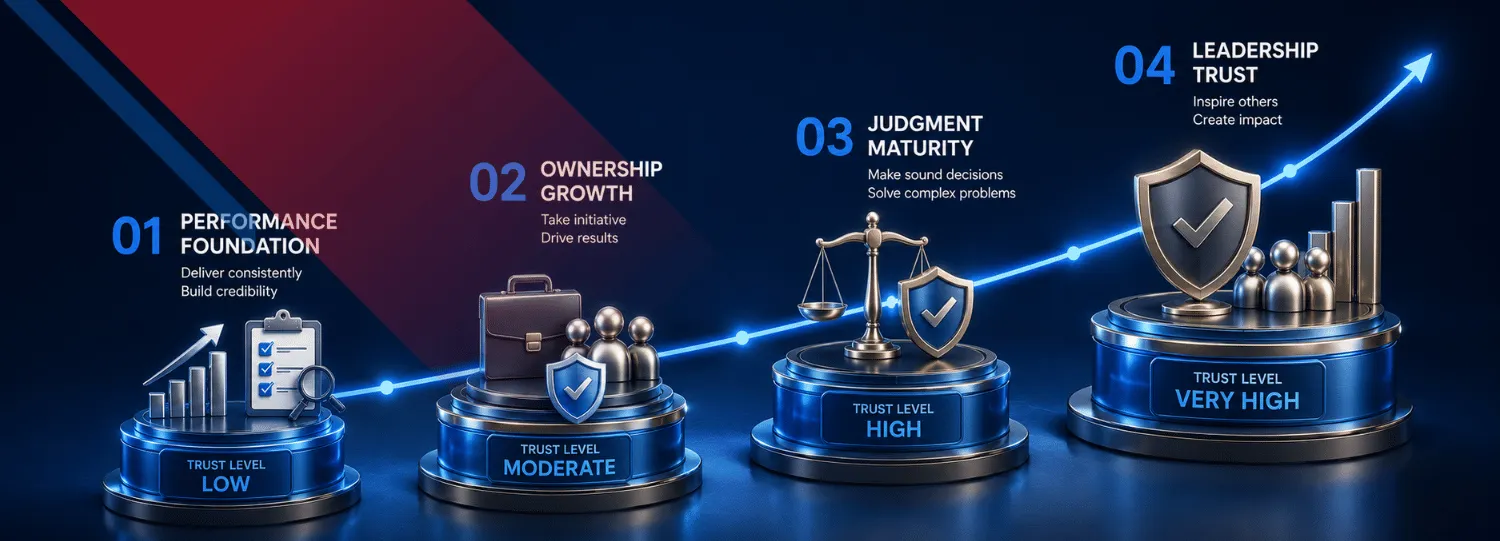
The first is judgment. Intelligent people can analyze information, but judgment determines what should be done with that information. In organizations, decisions are rarely made with complete certainty. There are budget limits, timing constraints, stakeholder concerns, incomplete data, and market risks. A professional with judgment can distinguish between what is urgent and what is important, what is a real risk and what is noise, what should be escalated and what can be resolved locally.
The second quality is ownership. Ownership does not mean saying yes to every request or working without boundaries. It means taking responsibility for outcomes, not merely activities. A task-focused employee may say, “I sent the presentation.” An ownership-oriented professional asks, “Did the presentation help the decision get made?” This distinction matters. Senior leaders trust people who close loops, anticipate dependencies, communicate risks early, and remain accountable without becoming defensive.
The third quality is enterprise thinking. At junior levels, people often optimize for their own task, team, or function. At senior levels, leaders must understand trade-offs across the organization. A marketing decision may affect margins. A finance decision may affect customer experience. A technology decision may affect scalability, compliance, and adoption. Senior leaders value people who can appreciate these interdependencies and avoid narrow functional thinking.
The fourth quality is learning agility. The half-life of many skills is shortening as artificial intelligence, automation, data systems, platform businesses, and new regulatory expectations reshape work. Learning agility is not simply attending training sessions. It is the ability to seek feedback, reflect on experience, adapt behaviour, and apply learning in new contexts. LinkedIn’s workplace learning research points to the growing importance of continuous learning and career development. For individuals, the message is direct: current competence matters, but visible learning capacity increasingly matters as much.
The fifth quality is emotional maturity. This is one of the most underestimated leadership capabilities. Senior leaders observe how people behave when they are challenged, criticized, delayed, or disappointed. Do they remain composed? Can they disagree respectfully? Do they give credit fairly? Can they handle confidential information? Do they build trust across teams? Harvard Business School Online’s discussion of emotional intelligence, drawing on Daniel Goleman’s work, reinforces the importance of self-awareness, self-regulation, empathy, and relationship management in leadership effectiveness.
The sixth quality is influence without authority. Much of modern work happens across reporting lines. Digital transformation, customer experience, compliance, innovation, and process improvement require collaboration among people who may not report to the same manager. Senior leaders notice those who can align stakeholders through clarity, credibility, and respect rather than through title or pressure.
Finally, senior leaders look for execution discipline. Strategic thinking is valuable, but only when it is connected to reliable action. Professionals who follow through, document decisions, manage timelines, surface risks, and keep stakeholders aligned create confidence. They make leadership easier because they reduce uncertainty around execution.
How This Plays Out in Real Organizations
The transition from performance to leadership readiness can be seen in many common workplace situations. Consider the high-performing employee who is promoted to manage former peers. The person may have succeeded through personal effort, speed, and technical expertise. But the new role requires delegation, coaching, prioritization, conflict resolution, and upward communication. If the person continues to behave like the strongest individual contributor, the team may become dependent, confused, or disengaged.
A similar pattern appears in digital transformation projects. A technically capable manager may understand the tool being implemented, but senior leadership will look for more than tool knowledge. Can the person explain the business case? Can they manage resistance? Can they coordinate between technology, finance, HR, operations, and users? Can they measure adoption rather than merely completion? The difference between implementing a system and leading change is significant.
This distinction is also visible in startups and growth-stage companies. In early phases, organizations may reward speed, improvisation, and personal drive. As they scale, however, leadership expectations change. The company needs process discipline, people development, governance, financial control, and cross-functional coordination. A person who succeeds in an unstructured environment may need to develop new habits to remain effective as complexity increases.
In larger Indian and global organizations, the same principle applies. Financial services firms need leaders who can balance growth, compliance, risk, and customer trust. Manufacturing and supply chain organizations need leaders who can manage cost, quality, resilience, and sustainability. Technology companies need professionals who can combine domain understanding with client empathy, data fluency, and execution discipline.
Gallup’s State of the Global Workplace 2025 points to pressure on employee engagement and the critical role of managers in shaping workplace experience. This is an important reminder that leadership is not abstract. Managers translate strategy into daily work. If they lack maturity, clarity, or trustworthiness, organizational execution suffers.
Deloitte’s 2025 Global Human Capital Trends also emphasizes that organizations are navigating complex tensions between performance, human sustainability, technology, and trust. Senior leaders, therefore, need people who can operate with nuance. Simplistic thinking is rarely enough.
Balanced Case Reflections: Why Success Stories Can Mislead
Leadership discussions often overuse exceptional success stories. We hear about founders who built companies early, executives who rose rapidly, or professionals who broke conventional rules. These examples may be inspiring, but they can also create survivorship bias. We notice visible successes and ignore the many cases where similar behaviours did not produce the same result.
A young professional who challenges every decision may be seen as bold in one context and immature in another. A manager who moves fast may be praised in a startup but considered risky in a regulated industry. A high performer who works independently may succeed in a specialist role but struggle when collaboration becomes essential.
This does not mean professionals should become cautious or passive. It means they must understand context. Leadership maturity involves knowing when to push, when to listen, when to escalate, when to pause, and when to build consensus. There is no universal formula for growth. Capability, timing, sponsorship, organizational need, and personal readiness all matter.
Senior leadership is usually not looking for perfection. It is looking for patterns of reliability. One mistake rarely defines a career, but repeated patterns do. A person who consistently demonstrates judgment, accountability, learning, and respect becomes easier to trust with larger responsibility.
Practical Implications for Students and Professionals
For BBA students, the lesson is to build leadership habits early. This does not require a formal title. Leadership potential can be seen in how students handle group assignments, internships, presentations, deadlines, disagreement, and feedback. The ability to communicate clearly, work responsibly with others, and connect concepts to real business problems is an early signal of professional maturity.
For MBA students and aspirants, the implication is deeper. Management education should not be treated only as a credential for promotion. Its real value lies in developing integrative thinking. A manager who understands finance but ignores people will struggle. A marketer who understands customers but ignores unit economics will struggle. An operations professional who understands process but ignores strategy will struggle. The strength of management learning lies in connecting these domains.
For early-career professionals, the practical question is not merely, “Am I doing my job well?” A more useful set of questions would be: Am I solving the real problem or only completing the assigned task? Do I understand how my work affects business outcomes? Can people trust me with ambiguity and pressure? Am I building relationships before I need influence? What evidence shows that I am learning faster than my role requires?
For first-time managers, the most important shift is from personal productivity to team effectiveness. Many new managers continue to measure their worth by how much they personally solve. But leadership requires enabling others to perform. Delegation, coaching, prioritization, and communication become central. A manager who remains the only reliable problem-solver may feel valuable, but over time may become a bottleneck.
For senior professionals seeking larger roles, the focus should move toward enterprise contribution. This means understanding the economics of the business, developing people, managing stakeholders, and making decisions that balance short-term outcomes with long-term capability. Visibility helps, but credibility sustains growth.
The Role of AI and the Rising Bar for Human Leadership
Artificial intelligence has made this discussion more urgent. As routine analysis, documentation, reporting, and coordination tasks become more automated, the human premium in organizations shifts toward judgment, ethics, problem framing, creativity, and influence. AI can assist with information. It cannot fully replace responsibility.
This distinction is important. The future manager will not be valued only for knowing more facts than others. Information is increasingly accessible. The future manager will be valued for asking better questions, interpreting context, making balanced decisions, and aligning people around action.
AI does not reduce the need for leadership capability. It raises the bar. When tools become more powerful, poor judgment becomes more costly. Senior leaders will therefore continue to look for professionals who combine technological fluency with human maturity and business understanding.
Conclusion: Leadership Readiness Is Built Before the Title Arrives
What senior leadership actually looks for is not mysterious, but it is often misread. Leaders do not only look for hard work, confidence, visibility, or technical expertise. They look for evidence of trustworthiness under complexity.
That evidence is built through judgment, ownership, learning agility, emotional maturity, enterprise thinking, influence, and disciplined execution. These qualities are not developed overnight, nor are they created by designation. They are built through repeated choices in ordinary professional situations: how one responds to feedback, handles pressure, frames problems, supports colleagues, communicates risk, and connects work to business value.
For students and professionals, this is an encouraging insight. Leadership readiness is not reserved for a few naturally gifted individuals. It can be developed deliberately through education, reflection, practice, and exposure to real problems. But it requires moving beyond the belief that effort alone guarantees growth.
Senior leadership does not simply ask who performed well in the last assignment. It asks who can be trusted with a larger future. The professionals who understand this distinction are better prepared not only to advance in their careers, but to create meaningful value when responsibility eventually arrives.
References / Sources Used
- World Economic Forum. The Future of Jobs Report 2025.
- LinkedIn Learning. Workplace Learning Report 2025.
- Harvard Business Publishing. How to Spot — and Develop — High-Potential Talent in Your Organization.
- McKinsey & Company. CEO Excellence: The Six Mindsets That Distinguish the Best Leaders from the Rest.
- Gallup. State of the Global Workplace 2025.
- Deloitte. 2025 Global Human Capital Trends.
- Harvard Business School Online. Articles and resources on emotional intelligence in leadership, drawing on Daniel Goleman’s framework.