
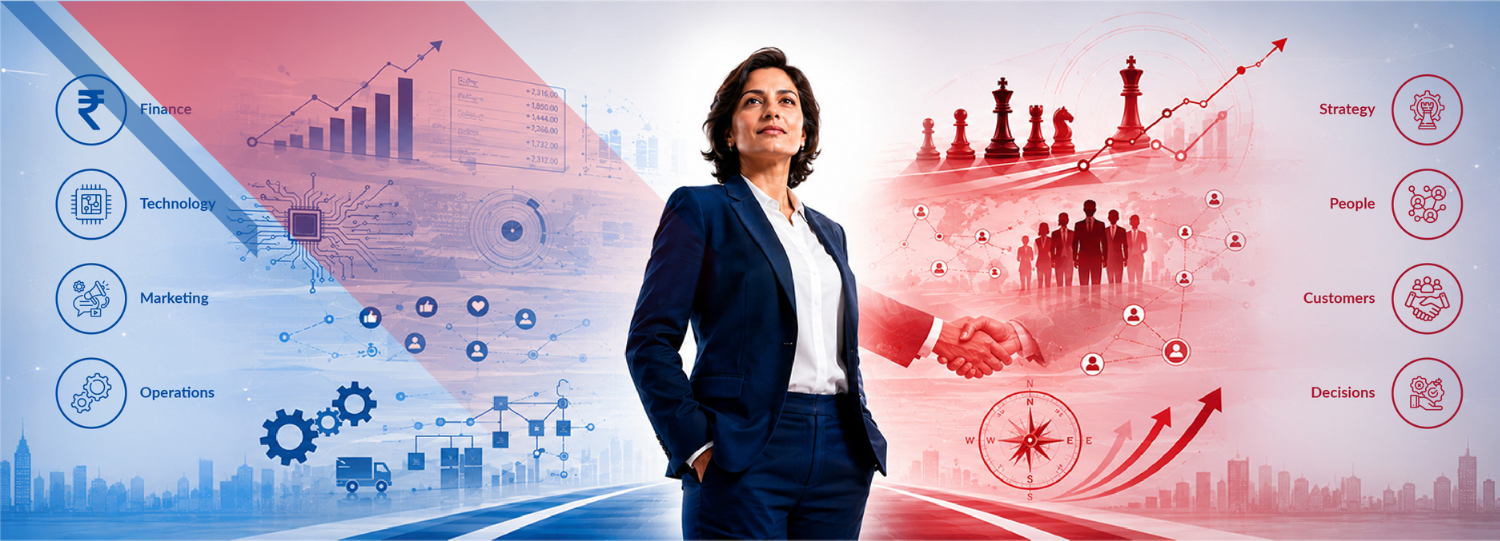
The Career Moment Where Expertise Is No Longer Enough
Most professional careers begin with depth. A finance analyst earns credibility through accuracy, modelling, and commercial discipline. A software engineer builds trust through technical problem-solving. A marketing professional demonstrates value through customer insight, campaign performance, or brand judgment. An operations specialist is respected for process control, execution discipline, and reliability.
In the early stages of a career, this depth is not optional. It is the foundation of professional credibility. Organizations trust people who can do something well, solve defined problems, and deliver measurable results.
Yet many professionals eventually encounter a difficult career moment. The same expertise that helped them grow begins to feel insufficient for the next level. The organization no longer asks only, “Can this person solve a functional problem?” It begins asking, “Can this person make decisions across functions, align people, manage uncertainty, and take responsibility for business outcomes?”
This is the transition from specialist to business leader.
It is one of the most important shifts in managerial careers, and also one of the most misunderstood. The transition is not simply about receiving a promotion, managing a larger team, or attending more meetings. It is a change in how a professional sees the organization, defines problems, exercises judgment, and creates value.
The need for this transition has become sharper because modern organizations are more interconnected than before. Digital transformation, artificial intelligence, global competition, changing consumer expectations, regulatory complexity, and new workforce models have made business problems less function-specific. The World Economic Forum’s Future of Jobs Report 2025 identifies analytical thinking, resilience, flexibility, leadership, and social influence among the most critical workplace capabilities. These are not narrow technical skills. They are integrative capabilities required to work across uncertainty, people, systems, and strategy.
For students, early-career professionals, and managers, the implication is clear: expertise remains necessary, but career growth increasingly depends on the ability to convert expertise into judgment.
The Misconception: The Best Specialist Will Naturally Become the Best Leader
Organizations often assume that the strongest individual performer is the obvious candidate for leadership. The best salesperson becomes the sales manager. The most dependable analyst becomes the finance lead. The strongest engineer becomes the technology manager. The highest-performing functional expert is promoted because they have already proved themselves.
This logic is understandable, but incomplete.
Specialist work and leadership work operate on different principles. Specialist work rewards precision, depth, control, and domain mastery. Leadership work demands prioritization, trade-offs, delegation, influence, communication, and decision-making under imperfect information.
A specialist often asks, “What is the technically correct answer?”
A business leader must ask, “What is the right decision given customer needs, financial constraints, execution risk, people capability, timing, and long-term consequences?”
The distinction matters because expertise can sometimes become a constraint. A professional who has grown through one function may continue to interpret every business issue through that function’s lens. A finance specialist may overemphasize cost discipline while underestimating innovation or customer experience. A technology specialist may optimize architecture while missing adoption, pricing, or usability. A marketing specialist may prioritize visibility without sufficient attention to margins or fulfilment capacity.
This does not make expertise less valuable. On the contrary, leaders with strong functional grounding often bring discipline and credibility to senior roles. The challenge is not to abandon expertise, but to avoid being trapped by it.
The leadership transition begins when the professional understands that their function is one part of a larger business system.
A Management Lens: Moving From Functional Depth to Systems Thinking
A useful way to understand this transition is through systems thinking. Systems thinking asks leaders to look at interdependencies rather than isolated events. A business is not a collection of independent departments. It is a living system of customers, employees, suppliers, capital, processes, technology, competitors, regulators, culture, and leadership choices.
Peter Senge’s work on learning organizations helped popularize the importance of seeing patterns, feedback loops, and system-wide consequences. For specialists moving into leadership, this idea is particularly relevant. The first task is to widen the frame of analysis.
A pricing decision, for example, is not only a marketing decision. It affects customer perception, sales conversion, margins, cash flow, competitor response, demand planning, and brand positioning. A hiring decision is not only an HR decision. It affects cost structure, capability building, managerial bandwidth, execution speed, and culture. A technology decision is not only a technical decision. It affects customer experience, scalability, security, adoption, compliance, and long-term flexibility.
This is why the movement from specialist to business leader requires a change in mental model. The specialist asks, “What is happening inside my function?” The business leader asks, “How does this decision affect the larger system?”
Michael Watkins’ work on leadership transitions, discussed widely through Harvard Business Review and Harvard Business School, reinforces this point. Moving into a broader role is not merely a change in title. It is a change in scope, stakeholder complexity, time horizon, and accountability. The professional must learn to diagnose the situation, build coalitions, understand context, and adapt leadership behaviour to the demands of the role.
The specialist is often evaluated for solving defined problems. The business leader is evaluated for defining the right problems, mobilizing others, and ensuring that solutions create enterprise value.
How This Plays Out in Organizations
In real organizations, the transition from specialist to business leader is visible in several ways.
First, leadership roles increasingly require cross-functional fluency. A product manager must understand technology, user behaviour, revenue, design, data, and operations. A business development leader must understand partnerships, legal risk, delivery capability, pricing, and market entry. A manufacturing leader must manage productivity, safety, quality, automation, workforce planning, sustainability, and customer commitments. Functional boundaries still exist, but the problems that matter most rarely remain within them.
Second, artificial intelligence and automation are changing the value of human work. Routine reporting, analysis, coordination, and execution are increasingly supported by digital tools. This does not mean that human judgment becomes less important. It means the opposite. As tools handle more procedural work, professionals are expected to demonstrate interpretation, ethical reasoning, stakeholder management, creativity, and leadership. The WEF’s emphasis on analytical thinking, leadership, and social influence reflects this broader shift.
Third, India’s business environment makes this transition especially relevant. As India continues to expand in services, technology, manufacturing, global capability centres, digital businesses, and entrepreneurship, organizations need professionals who can do more than execute tasks. NASSCOM’s Technology Sector in India: Strategic Review 2025 highlights India’s growing role as a global technology and innovation hub. Such growth requires not only technical specialists but also professionals who can manage clients, lead distributed teams, understand business models, and translate capability into value.
Fourth, companies are under pressure to build leadership pipelines faster. McKinsey’s work on leadership transitions has repeatedly emphasized that role transitions are moments of both opportunity and risk. Many capable professionals struggle not because they lack intelligence, but because they enter broader roles without sufficient preparation for stakeholder complexity, ambiguity, and enterprise accountability.
This is visible at many levels: first-time managers, project leads, functional heads, business unit leaders, and senior executives. In each case, the challenge is not simply to do more. It is to think differently.
What Actually Changes in the Transition?
The shift from specialist to business leader can be understood through a few core movements.
From Personal Problem-Solving to Building Team Capability
Specialists often earn recognition by being the person who knows the answer. Leaders must learn to build conditions in which others can think, decide, and execute effectively.
This is difficult because expertise can become part of professional identity. A newly promoted manager may continue to solve every problem personally because it feels faster, safer, or more satisfying. But over time, this creates dependency and bottlenecks. The leader remains busy, the team remains underdeveloped, and the organization does not gain scale.
Leadership requires delegation, coaching, feedback, and role clarity. The question changes from “How do I solve this?” to “How do I help the team become capable of solving this well?”
From Functional Metrics to Business Outcomes
Every function has its own indicators. Marketing tracks reach, leads, conversion, and brand measures. Finance tracks cost, margins, working capital, and variance. Operations tracks efficiency, quality, and productivity. Human resources tracks hiring, retention, engagement, and performance processes.
These metrics are useful, but leadership requires understanding what they mean for the business as a whole. A sales team may increase revenue by discounting too aggressively. A cost team may reduce expenses in ways that weaken customer experience. A technology team may release features that are elegant but commercially irrelevant. An HR team may improve process efficiency without addressing capability gaps.
A business leader must ask whether functional performance is creating real enterprise value. Metrics are not the destination. They are signals that must be interpreted in context.
From Certainty to Judgment Under Ambiguity
Specialist work often allows for more controlled problem-solving. Leadership rarely does. Business decisions frequently involve incomplete information, competing priorities, and uncertain consequences. Waiting for perfect clarity can be as damaging as acting without thought.
Judgment becomes central here. Judgment is not guesswork. It is the disciplined use of evidence, experience, consultation, scenario thinking, and ethical consideration. Good leaders ask: What do we know? What are we assuming? What could go wrong? Who is affected? What is reversible? What must be decided now?
This ability to decide responsibly under ambiguity is one of the defining features of leadership maturity.
From Expertise-Based Authority to Stakeholder Influence
Specialists influence others through knowledge. Leaders must influence through credibility, trust, communication, and alignment.
This is especially important when outcomes depend on people who do not report directly to the leader. Most significant business decisions require cooperation across departments. A leader may need support from finance, technology, operations, legal, sales, external partners, and senior leadership. Technical correctness alone rarely creates alignment.
The ability to translate complex issues into clear business language becomes essential. A leader must communicate not only what should be done, but why it matters, what trade-offs are involved, and how different stakeholders will be affected.
From Functional Identity to Enterprise Responsibility
Perhaps the hardest transition is psychological. Specialists often identify strongly with their function. A finance person may see themselves as the guardian of discipline. A marketer may see themselves as the voice of the customer. A technologist may see themselves as the protector of product quality.
These identities are valuable. But business leadership requires a larger identity. The leader must act in the interest of the enterprise, not only the function from which they emerged.
This does not mean compromising professional standards. It means placing them within a broader judgment. A business leader cannot permanently behave as the representative of one department. They must learn to represent the organization’s larger purpose.
Balanced Examples From the Workplace
The transition can be seen clearly in technology roles. A strong engineer moving into product or business leadership brings valuable technical understanding. This helps in assessing feasibility, complexity, quality, and scalability. But if the leader remains focused only on technical elegance, they may miss customer adoption, pricing, usability, service design, or commercial viability. Effective product leadership does not reject technical depth. It connects technical possibility with customer and business value.
In banking and financial services, a risk specialist moving into business leadership faces a different challenge. Excessive risk aversion can slow growth, while careless expansion can create regulatory and reputational damage. Leadership lies in balancing opportunity and control. The leader must neither romanticize growth nor hide behind caution.
In manufacturing, an operations specialist moving into plant or business leadership must think beyond throughput and efficiency. They must consider workforce safety, quality culture, supplier reliability, capital investment, sustainability expectations, and customer commitments. The problem is no longer only operational optimization. It is business stewardship.
These examples also require balance. Not every specialist needs to become a general business leader. Some professionals create exceptional value as deep experts, researchers, architects, analysts, designers, consultants, doctors, scientists, or scholars. Organizations need deep expertise as much as they need broad leadership.
The argument, therefore, is not that leadership is superior to specialization. It is that professionals who aspire to broader responsibility must deliberately build capabilities beyond specialization.
Practical Implications for Students and Professionals
For BBA students, the most important lesson is to build breadth early. Subjects such as accounting, economics, marketing, operations, analytics, organizational behaviour, and strategy should not be treated as separate academic compartments. They are different languages of business. The earlier students learn to connect them, the stronger their managerial foundation becomes.
For MBA students and aspirants, the transition requires deeper reflection. An MBA should not be viewed only as a credential for promotion. Its value lies in helping professionals move from functional execution to structured managerial thinking. Case discussions, simulations, group projects, internships, and applied learning matter because they expose learners to ambiguity, trade-offs, and cross-functional decision-making.
For early-career professionals, the first step is to understand how the business actually works. Many employees understand their tasks but not the business model. They should ask: Who is the customer? What problem are we solving? How does the organization earn revenue? What drives cost? What creates risk? What differentiates us? Where does my work connect to value?
For first-time managers, the priority is to move from personal productivity to team productivity. This requires setting expectations, giving feedback, building trust, developing others, and creating decision discipline. Many new managers struggle not because they are incapable, but because they continue to behave like individual contributors.
For mid-career professionals, the task is to build cross-functional credibility. This can be done by volunteering for projects beyond one’s department, learning financial basics, understanding customer journeys, improving written and spoken communication, studying industry structure, and seeking mentors outside one’s function.
For organizations, the implication is equally important. Leadership transitions should not be left to chance. A promotion is not the same as preparation. Organizations need role clarity, coaching, stakeholder mapping, feedback systems, and structured exposure to enterprise-level decision-making.
What a Specialist Must Learn Before Becoming a Business Leader
A specialist aspiring to business leadership should consciously develop six capability areas.
The first is financial literacy. Every leader must understand revenue, margins, cost, cash flow, investment, and return. Without financial understanding, business leadership remains incomplete.
The second is customer understanding. Leaders must know who the organization serves, what customers value, how trust is built, and how trust is lost.
The third is people leadership. This includes hiring, delegation, feedback, conflict management, motivation, performance conversations, and inclusion.
The fourth is strategic thinking. Leaders must understand competition, positioning, trade-offs, timing, and long-term consequences.
The fifth is communication. The ability to write clearly, present decisions, frame problems, and align stakeholders is central to leadership effectiveness.
The sixth is ethical judgment. Business decisions affect employees, customers, investors, communities, and institutions. Leadership without ethical judgment can create short-term results and long-term damage.
These capabilities cannot be built through reading alone. They require practice, feedback, reflection, and exposure to real decisions.
Conclusion: Expertise Opens Doors; Leadership Expands Responsibility
The transition from specialist to business leader is one of the defining shifts in a professional career. It is also one of the easiest to underestimate. Many professionals assume that strong performance in one domain will automatically prepare them for broader leadership. In reality, the transition requires a deliberate expansion of perspective.
Expertise remains the foundation. It gives professionals credibility, discipline, and the ability to understand problems deeply. But business leadership requires something more: the capacity to see interdependencies, make trade-offs, influence stakeholders, develop people, and take responsibility for outcomes beyond one’s function.
For students, this means learning business as an interconnected system rather than a set of isolated subjects. For working professionals, it means preparing for leadership before the promotion arrives. For organizations, it means treating leadership transition as a capability-building journey, not merely an administrative change in title.
Specialist expertise may open the first doors of a career. Business leadership requires the maturity to see the wider room.
References :
- World Economic Forum. The Future of Jobs Report 2025.
- McKinsey & Company. Successfully Transitioning to New Leadership Roles.
- Harvard Business Review / Harvard Business School. Michael D. Watkins’ work on leadership transitions.
- Harvard Business School Working Knowledge. Making the Move to General Manager.
- Deloitte. 2025 Global Human Capital Trends: Turning Tensions into Triumphs.
- NASSCOM. Technology Sector in India: Strategic Review 2025.
- India Skills Report 2025.