
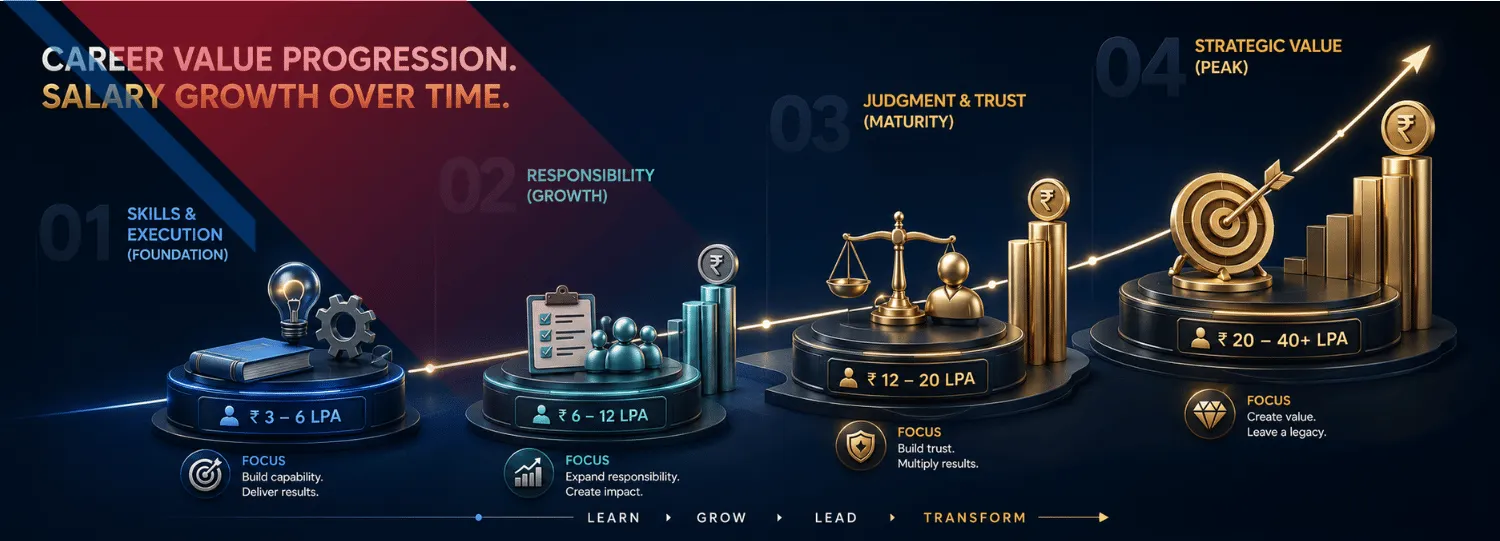
Salary growth is one of the most practical concerns in any career conversation, yet it is often discussed in surprisingly shallow terms. Students want to know which specialization will pay more. Early-career professionals compare job offers by immediate compensation. Mid-career managers wonder whether they should change companies, pursue further education, move into leadership, or build deeper expertise.
These are valid questions. Compensation affects financial security, professional confidence and career choices. But the deeper issue is not simply how to earn more in the next appraisal cycle. The more important question is: what makes a professional’s economic value increase over time?
The answer is not as simple as hard work, years of experience, frequent job changes or negotiation. All these factors can matter, but none of them guarantees sustained salary growth. Many sincere professionals work hard for years without meaningful compensation acceleration. Some change jobs regularly but eventually plateau. Others grow steadily within the same organization because they become trusted with increasingly complex work.
Salary growth, viewed properly, is not merely a reward for time spent in employment. It is the market’s recognition of accumulated capability, relevance, credibility and trust.
This question has become especially important because labour markets are being reshaped by technology, automation, artificial intelligence, demographic shifts and new business models. The World Economic Forum’s Future of Jobs Report 2025 highlights that analytical thinking, technological literacy, resilience, flexibility and creative thinking are becoming central to future employability. The implication is clear: the market is not only rewarding what people know, but how quickly they can adapt, apply judgment and create value in changing contexts.
For Indian students and professionals, the issue is even more layered. India’s labour market is large, diverse and uneven. PLFS 2023–24 shows that self-employment continues to form a major share of India’s workforce, while regular wage and salaried employment represents a smaller segment. This means salary growth must be understood not only as an individual achievement, but also as a function of industry structure, productivity, skills, access to opportunity and the nature of formal employment.
The Misconception: Experience Alone Does Not Drive Salary Growth
The most common misunderstanding about salary growth is the belief that experience automatically creates higher pay. In formal resumes, experience is counted in years. In organizations, however, experience is valued through contribution.
Five years of progressively complex work is very different from five years of repeated routine work. A professional may become faster at performing familiar tasks, but that does not necessarily make them more valuable in the labour market. Salary growth depends on whether experience has been converted into capability.
This distinction matters because employers rarely pay only for effort or loyalty. They pay for expected contribution. They pay for people who can solve problems, reduce risk, lead teams, handle customers, interpret ambiguity, improve systems, manage complexity and make decisions that protect or grow business value.
There is another misconception as well: salary growth is purely personal. It is not. Compensation is shaped by the interaction between individual capability and market demand. A highly capable professional in a low-growth, low-margin sector may face slower compensation movement than a moderately capable professional in a fast-growing sector where talent is scarce. At the same time, market momentum alone is rarely enough for long-term growth. When industries mature or demand cools, underlying capability becomes more visible.
The more mature view is that salary growth emerges from the alignment of three forces: what a person can do, what the market needs, and how credibly that capability is recognized.
A Useful Academic Lens: Human Capital and Signalling
Human capital theory offers a strong conceptual foundation for understanding salary growth. Economists such as Gary Becker argued that education, training, experience and skill development can increase a person’s productive capacity. From this perspective, learning is not only an academic activity; it is an investment in future economic contribution.
However, capability alone does not always translate into higher compensation. The labour market must also be able to see and trust that capability. This is where signalling theory, associated with Michael Spence, becomes relevant. Degrees, institutions, job titles, employers, certifications, promotions, high-quality projects and professional references all act as signals. They help employers estimate a person’s capability before fully observing it.
The practical implication is important. Sustainable salary growth requires both substance and signal. A professional who builds only signals without real capability may grow in the short term but eventually face performance limits. A professional with strong capability but weak visibility may remain under-recognized. The strongest careers usually combine demonstrable skill, credible evidence and market relevance.
McKinsey Global Institute’s research on human capital at work reinforces this idea. It argues that work experience itself can become a powerful source of human capital when people move through roles that build new skills and expand responsibility. In other words, a job is not merely a place where income is earned. It is also a site where future earning capacity is either strengthened or limited.
This is why two professionals with similar educational qualifications can experience very different salary trajectories. The difference often lies not in the degree alone, but in how each person uses work experience to build judgment, domain knowledge, leadership capacity and market credibility.
Salary Growth Follows the Complexity of Problems Solved
One of the clearest drivers of long-term salary growth is the increasing complexity of problems a professional can handle.
Early in a career, organizations often reward accuracy, discipline, responsiveness and the ability to complete assigned tasks reliably. These are important foundations. But over time, the basis of compensation changes. Professionals are expected to move beyond execution towards diagnosis, coordination, decision-making and leadership.
A junior employee may be paid to prepare a report correctly. A mid-level professional may be paid to interpret that report and recommend action. A senior manager may be paid to decide which problem deserves attention, which risks matter, which stakeholders must be aligned, and which trade-offs the organization should accept.
This movement from task execution to problem ownership is central to salary growth. The market rewards people who reduce uncertainty for organizations. A professional who can take an ambiguous problem, structure it, involve the right people, evaluate options and deliver a responsible outcome becomes more valuable than someone who only performs predefined work.
This is especially relevant in management careers. The transition from individual contributor to manager is not simply a promotion in title. It is a shift in the nature of value creation. The manager is increasingly judged not only by personal productivity, but by the quality of decisions, the performance of teams, the ability to prioritize and the capacity to align people around outcomes.
The Role of Skills: Scarcity, Transferability and Relevance
Skills drive salary growth when they are scarce, transferable and relevant to business outcomes.
A scarce skill is not easily available in the labour market. A transferable skill can be applied across roles, organizations or industries. A relevant skill is connected to problems that organizations are willing to pay to solve. Salary growth is strongest when all three conditions are present.
For example, data interpretation, financial analysis, enterprise sales, product thinking, regulatory understanding, supply chain analytics, strategic communication, people leadership and digital fluency can create value across multiple sectors. These skills are not tied only to one designation. They travel with the professional.
By contrast, a narrow process skill that is useful only within one internal system may support current employment but may not significantly increase external market value. The distinction is not between technical and non-technical skills. Both can be valuable. The real distinction is between skills that expand opportunity and skills that confine a person to a narrow role.
The OECD’s work on skills and lifelong learning emphasizes the importance of continuous skill development in economies undergoing technological and structural change. This applies directly to students and working professionals. The question is not only whether one has completed a course or earned a certificate. The question is whether one can use new knowledge to solve more meaningful problems.
This is where many professionals make a mistake. They accumulate credentials without converting them into performance. The market eventually distinguishes between certification and capability.
Industry Economics Also Shapes Compensation
It is tempting to view salary growth only as an individual outcome. But compensation is also shaped by industry economics.
Some sectors are structurally able to pay more because they operate with higher productivity, stronger margins, scalable business models or greater dependence on specialized talent. Others may employ large numbers of people but have limited room for compensation expansion because margins are thin or productivity per worker is low.
The RBI’s KLEMS database, which tracks productivity-related variables across Indian industries, is a useful reminder that employment and productivity are not the same. A sector may generate many jobs but not necessarily high wage growth. Similarly, a sector may employ fewer people but offer stronger compensation because each employee contributes to higher-value output.
This matters for career planning. A professional’s salary growth depends partly on the economic engine of the sector they are in. Consulting, financial services, digital platforms, analytics, software, healthcare technology, advanced manufacturing and AI-enabled services may reward certain capabilities more aggressively because those capabilities directly influence revenue, efficiency, risk management or scale.
However, this does not mean that career value exists only in fashionable industries. Every sector needs capable managers, analysts, operators, communicators and leaders. The more useful insight is that professionals should understand how their industry creates value. When individuals understand the economics of their sector, they can position themselves closer to the activities that matter most.
Career Mobility Matters, But Only When It Builds Capability
Job changes can accelerate salary growth, especially in markets where external hiring is rewarded more than internal progression. But mobility is not automatically the same as career advancement.
A move that offers higher pay but narrows learning may be beneficial in the short term but limiting over the long term. Conversely, a move that expands responsibility, improves exposure or builds scarce capability may create stronger future salary growth even if the immediate increment is modest.
McKinsey’s research on human capital highlights the role of work experience and role movement in building lifetime earnings. The deeper insight is that mobility matters when it helps a professional acquire or deploy new skills. Random movement can create a fragmented career. Purposeful movement can create a compounding one.
For students and early-career professionals, this is especially important. The first salary after graduation matters, but it should not be the only lens through which a role is evaluated. A good early role provides learning density. It exposes the individual to customers, data, operations, commercial decisions, technology, teamwork or managerial thinking. These experiences create future earning capacity.
For mid-career professionals, the question becomes more strategic. A role should be assessed not only by designation and pay, but by whether it expands decision rights, leadership scope, business understanding or market credibility.
Trust Becomes a Compensation Driver at Higher Levels
At senior levels, salary growth depends increasingly on trust.
Organizations pay a premium for professionals who can be trusted with ambiguity, teams, customers, capital, reputation and decisions that have consequences. This trust is not built through confidence alone. It is built through repeated evidence of judgment.
Does the person make balanced decisions? Can they communicate risk clearly? Do they understand the commercial implications of their recommendations? Can they lead without unnecessary conflict? Can they manage difficult stakeholders without damaging relationships? Can they deliver outcomes without constant supervision?
These questions often determine whether a professional is seen as ready for larger responsibility. Technical competence remains important, but it becomes insufficient on its own. Many technically strong professionals reach a plateau because they do not develop communication, delegation, business judgment or organizational maturity.
This is one reason management education, when approached seriously, can be valuable. Its purpose is not simply to add a credential. It can help professionals connect functional knowledge with economics, strategy, people management, data, ethics and decision-making. Salary growth at higher levels often depends on this integrative capacity.
AI makes this point even sharper. As routine analysis and process work become more automated, human judgment does not disappear. It becomes more important. The professional who can combine technological fluency with contextual understanding and ethical decision-making is likely to remain valuable in a changing workplace.
A Balanced View: Why Careers Grow Differently
Consider three professionals who begin with similar qualifications.
The first becomes highly efficient in a narrow operational role but avoids unfamiliar responsibilities. This person may be valued for reliability, but salary growth eventually slows because the scope of contribution does not expand.
The second changes jobs frequently for higher increments but does not build depth. This may produce early compensation gains, but over time employers may question whether the person can handle sustained ownership or larger responsibility.
The third professional chooses roles that gradually increase complexity. The progression may begin with execution, move into analysis, then client or stakeholder exposure, then team leadership, and eventually business ownership. This path may not always produce the highest immediate increment, but it often builds more durable career value.
This is not a formula, and it should not be romanticized. Career outcomes are influenced by industry cycles, geography, family responsibilities, gender, access to networks, organizational culture and economic conditions. The ILO’s Global Wage Report 2024–25 reminds us that wage trends and wage inequality vary significantly across countries and worker groups. Salary growth must therefore be understood with both individual agency and structural realism.
Still, within these constraints, individuals do make choices that affect their long-term value. They can choose learning over comfort, depth over surface-level movement, credibility over exaggeration, and skill-building over mere activity.
Practical Implications for Students, Professionals and Managers
For BBA students, the foundation matters. Accounting, economics, statistics, communication, digital tools and business awareness are not merely subjects to be cleared. They are early building blocks of employability. Internships should be evaluated not only by brand name, but by what they allow the student to observe and learn.
For MBA aspirants and learners, the key is to convert experience into structured thinking. Management education has value when it helps a learner understand decisions more deeply: why markets behave as they do, how organizations allocate resources, how teams function, how customers decide, how strategy is executed, and how data informs judgment. The degree may open doors, but sustained salary growth depends on the capability built behind the degree.
For early-career professionals, the main advice is to avoid optimizing every decision only for immediate compensation. Salary matters, but so does the learning curve. A role that builds scarce skills, measurable outcomes and wider exposure may be more valuable than a slightly higher-paying role that keeps one confined to routine work.
For mid-career professionals, growth increasingly depends on the ability to create value through others. This requires delegation, coaching, prioritization, stakeholder management and commercial understanding. A manager who remains only the best individual performer may struggle to scale.
For business leaders, the implication is organizational. If companies want future-ready talent, compensation systems should not reward tenure alone. They should recognize capability growth, learning agility, internal mobility, leadership behaviour and contribution to business outcomes. Otherwise, organizations will remain dependent on expensive external hiring while underutilizing internal talent.
Conclusion: Salary Growth Is the Result of Compounded Career Value
Salary growth over time is shaped by many factors: education, skills, experience, industry economics, productivity, mobility, negotiation, networks, leadership and timing. But underneath these factors lies one central principle: compensation grows when a professional’s contribution becomes more valuable, more visible and harder to replace.
The issue is not whether professionals should pursue salary growth. They should. Compensation is an important economic signal and a legitimate career concern. But it must be pursued intelligently. A rising salary without rising capability may not be sustainable. Strong capability without visibility may remain under-rewarded. Frequent movement without depth may create short-term gains but long-term fragility.
For students and professionals, the better career question is not simply, “How do I get the next increment?” A more useful question is, “What capability am I building that the market will continue to value three, five and ten years from now?”
The answer to that question shapes not only salary growth, but the quality and resilience of a career.
References / Sources Used
- World Economic Forum. The Future of Jobs Report 2025.
- McKinsey Global Institute. Human Capital at Work: The Value of Experience.
- International Labour Organization. Global Wage Report 2024–25: Is Wage Inequality Decreasing Globally?
- OECD. OECD Skills Outlook 2023.
- Reserve Bank of India. India KLEMS Database: Measuring Productivity at the Industry Level.
- Ministry of Statistics and Programme Implementation. Periodic Labour Force Survey Annual Report 2023–24.
- NASSCOM and Deloitte. Advancing India’s AI Skills: Interventions and Programmes Needed.