Supply Chains Are No Longer Invisible
A customer who receives a product late rarely thinks about procurement delays, port congestion, supplier dependency, warehouse capacity, demand forecasting errors, or transportation constraints. The customer simply experiences a broken promise.
That is why supply chains have moved from the background of business to the centre of management attention. For many years, supply chain decisions were seen as specialist operational concerns. They were important, certainly, but largely handled by procurement teams, logistics managers, factory planners, warehouse heads, and operations professionals. Senior leaders and functional managers often engaged with supply chains only when costs rose or delivery failed.
The last few years have challenged that view. The pandemic, semiconductor shortages, geopolitical conflicts, climate-related disruptions, freight volatility, cyber risks, and sudden shifts in consumer demand have shown that supply chains are not merely support systems. They shape revenue, customer trust, working capital, competitiveness, and business continuity.
A company may have a strong brand, a sound strategy, and attractive demand. Yet if it cannot source materials, manage inventory, coordinate suppliers, fulfil orders, and respond to disruption, its strategy remains incomplete. In this sense, supply chains reveal an uncomfortable truth about management: good ideas succeed only when operating systems can carry them.
For future managers, this is a critical lesson. Supply chain literacy is no longer relevant only for those choosing careers in operations or logistics. Marketing managers, finance professionals, product managers, entrepreneurs, consultants, analysts, and general managers all need to understand how supply chains behave under pressure. They do not need to become technical specialists, but they must learn to think operationally.
The Misconception: Efficiency Is Always the Highest Goal
The most common misunderstanding about supply chains is that the best supply chain is always the most efficient one. This view has shaped decades of management practice. Reduce inventory. Consolidate suppliers. Lower logistics costs. Improve asset utilisation. Shorten cash cycles. Eliminate waste.
These goals are not wrong. Wasteful operations weaken profitability. Excess inventory blocks capital. Poor coordination increases cost. Inefficient movement of goods affects both margins and customer experience.
The problem begins when efficiency is treated as the only measure of good management.
A supply chain can be financially efficient in normal conditions and fragile in abnormal ones. A company that depends on one supplier, one geography, one transport route, or one distribution centre may appear highly efficient when the environment is stable. Its costs may be low, its inventory may be lean, and its return on assets may look strong. But the same design can become a serious weakness when disruption occurs.
The cost saved in stable conditions may be much smaller than the loss created during a shock.
This does not mean that lean operations or just-in-time principles are outdated. The lesson is more nuanced. Lean systems work best when supported by process discipline, supplier reliability, information visibility, quality control, and problem-solving capability. Low inventory by itself is not excellence. It becomes valuable only when the wider operating system is capable of coordination and responsiveness.
The more mature managerial question, therefore, is not simply: “How do we reduce cost?” It is: “What balance of cost, flexibility, visibility, and redundancy creates the best risk-adjusted performance for this business?”
That distinction is central to modern management.
A Management Lens: Supply Chains as Interconnected Systems
One of the most useful ways to understand supply chains is through systems thinking. A supply chain is not a straight line from supplier to customer. It is an interconnected network of decisions, dependencies, feedback loops, and trade-offs.
A marketing campaign can increase demand. That demand affects production planning. Production affects procurement. Procurement affects supplier capacity. Supplier capacity affects delivery timelines. Delivery timelines affect customer satisfaction. Customer satisfaction affects revenue, reputation, and future demand.
When each function acts independently, the system becomes unstable.
The classic “bullwhip effect,” discussed by Hau Lee, V. Padmanabhan, and Seungjin Whang, explains how small changes in customer demand can become amplified as they move upstream through the supply chain. Retailers may over-order because they fear shortages. Distributors may further inflate demand signals. Manufacturers may interpret temporary spikes as long-term trends. The result can be excess inventory in one part of the system and shortages in another.
This is not only a supply chain problem. It is a management problem.
It shows why functional silos damage business performance. Sales teams, finance teams, procurement teams, operations teams, and technology teams cannot make decisions in isolation and expect the organisation to remain balanced. Each decision creates consequences elsewhere.
Sunil Chopra’s supply chain framework is useful here because it identifies key supply chain drivers such as facilities, inventory, transportation, information, sourcing, and pricing. Each driver involves a trade-off between efficiency and responsiveness. Faster delivery often costs more. More inventory improves availability but increases carrying cost. Supplier diversification reduces dependency but adds complexity. Better data systems improve visibility but require investment and disciplined use.
Supply chain management, therefore, is not merely about moving goods. It is about making decisions under uncertainty while balancing cost, service, risk, and adaptability.
How Supply Chain Disruptions Affect Real Organisations
In real organisations, supply chain disruption rarely appears as a neat textbook case. It appears as a delayed shipment, a missing component, a sudden freight increase, a vendor quality issue, a warehouse bottleneck, a regulatory change, a cyberattack, or an unexpected surge in demand.
For a consumer goods company, disruption may mean stockouts during a festive sales period. For an automobile manufacturer, one unavailable semiconductor can delay production of an entire vehicle. For a pharmaceutical company, supply chain reliability is tied to compliance, patient safety, and public trust. For an e-commerce business, last-mile delivery is not just logistics; it is part of the customer experience. For food and grocery companies, cold-chain failures can affect quality, waste, safety, and reputation.
The Indian context makes this discussion especially relevant.
India’s ambitions in manufacturing, e-commerce, pharmaceuticals, electronics, food processing, exports, and digital commerce require stronger logistics and supply chain capabilities. Initiatives such as the National Logistics Policy, PM Gati Shakti, and the Unified Logistics Interface Platform reflect a broader recognition that infrastructure, multimodal connectivity, data integration, and logistics efficiency are central to economic competitiveness.
Government of India sources have described PM Gati Shakti as a GIS-enabled platform that integrates infrastructure data across roads, railways, ports, inland waterways, telecom, and power networks. The significance of such initiatives goes beyond infrastructure creation. They are attempts to reduce coordination failure in a complex economy.
For managers, this matters because supply chain capability increasingly intersects with strategy. Businesses that can design reliable, data-enabled, and flexible operating systems are better positioned to serve customers and manage uncertainty. Those that treat supply chains only as cost centres may struggle when markets become volatile.
Learning from Examples Without Oversimplifying Them
Supply chain discussions often refer to well-known examples: Toyota and lean manufacturing, Apple and supplier orchestration, Zara and fast fashion, Amazon and logistics scale, or the global semiconductor shortage. These examples are useful, but they must be read carefully.
Toyota is frequently associated with just-in-time manufacturing, but the deeper lesson from Toyota is not simply low inventory. It is disciplined process design, supplier development, quality systems, continuous improvement, and the ability to identify and solve problems close to where they occur. Just-in-time works only when the system supporting it is mature.
The semiconductor shortage offered a different lesson. Some supply chains cannot be adjusted quickly because they depend on long investment cycles, specialised capacity, technical complexity, and concentrated expertise. When demand shifts faster than capacity can respond, even large and sophisticated firms face limits.
E-commerce provides another important case. Digital platforms may create demand rapidly, but fulfilment capacity determines whether the customer promise is delivered. A seamless app interface cannot compensate for poor warehouse execution, unreliable delivery, weak reverse logistics, or poor inventory accuracy. In digital commerce, operations and technology are not separate worlds; they are deeply connected.
These examples caution against copying fashionable practices without understanding context. A supply chain model that works for automobiles may not work for pharmaceuticals. A model suited to luxury goods may not work for grocery. A strategy effective for software may not apply to heavy manufacturing. Good managers do not imitate supply chain practices mechanically. They interpret them in relation to industry structure, customer expectations, product characteristics, risk exposure, and organisational capability.
What Future Managers Should Practically Understand
The first practical requirement is the ability to read operational signals. Metrics such as forecast accuracy, inventory turnover, lead time, fill rate, service level, supplier reliability, logistics cost, returns rate, and working capital are not narrow operational measures. They reveal the health of the business system.
A manager who ignores these indicators may misunderstand the economics of the organisation.
The second requirement is an understanding of trade-offs. Resilience is not free. Dual sourcing, safety stock, regional warehousing, supplier audits, digital control towers, and contingency planning all require investment. But fragility also has a cost. The managerial task is not to build redundancy everywhere. It is to identify where disruption would be most damaging and design appropriate protection.
The third requirement is cross-functional thinking. Supply chain decisions affect finance, sales, technology, HR, legal, sustainability, and customer experience. A future manager should be able to ask practical questions: What happens if a critical supplier fails? How would rising freight costs affect margins? What assumptions are built into our demand forecast? How much cash is tied up in inventory? Which processes depend on informal knowledge rather than documented systems? Where do we lack visibility?
The fourth requirement is supplier relationship capability. In a volatile environment, suppliers are not merely vendors to be pressured on price. They are partners in risk management, innovation, continuity, and learning. Strong supplier relationships do not eliminate disruption, but they improve communication, prioritisation, and joint problem-solving when disruption occurs.
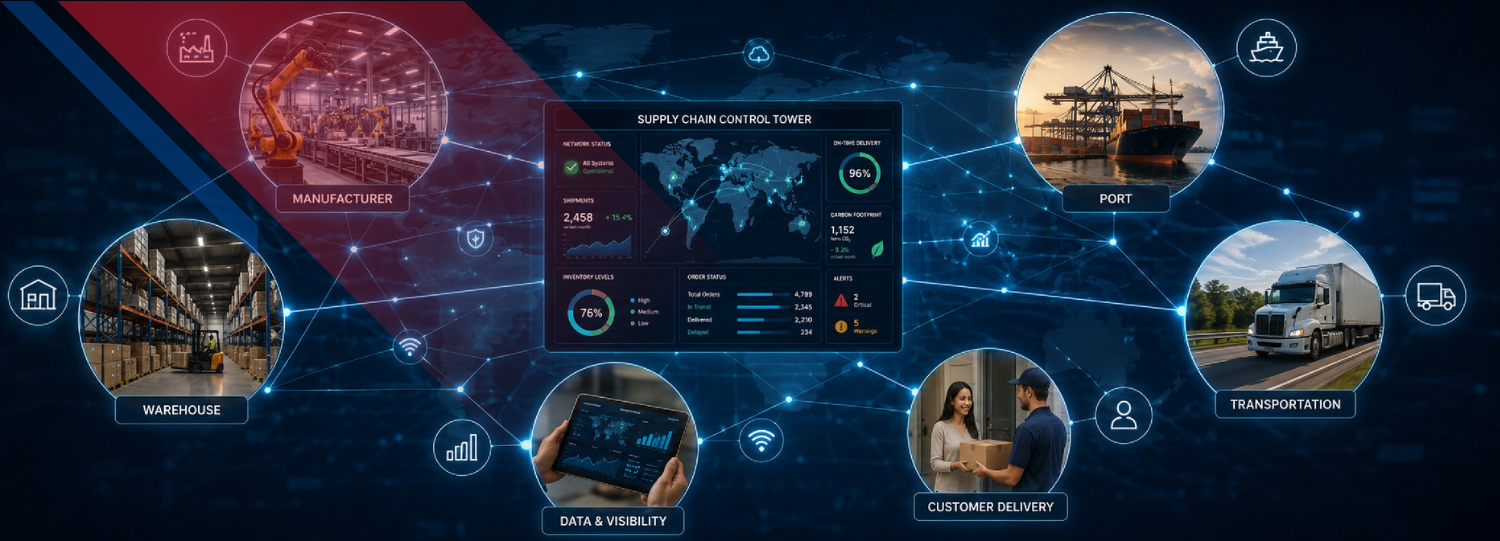
The fifth requirement is digital judgment. Artificial intelligence, predictive analytics, IoT, warehouse automation, logistics platforms, and supply chain control towers can improve visibility and responsiveness. But technology does not automatically create resilience. Data quality, process discipline, accountability, and managerial interpretation remain essential. A dashboard is useful only when decision-makers know what the signal means and how to act on it.
The sixth requirement is sustainability awareness. Climate risk, emissions, packaging waste, ethical sourcing, circularity, and regulatory pressure are now part of supply chain design. A supply chain exposed to environmental, reputational, or compliance risk cannot be considered fully resilient. Future managers will need to understand sustainability not as a separate reporting topic, but as part of operating strategy.
Implications for Students, Professionals, and Leaders
For BBA students, supply chains provide a practical way to understand how business functions connect. Operations is not only about factories and warehouses. It is about how decisions move through organisations and markets.
For MBA students and working professionals, supply chain literacy strengthens managerial credibility. A manager who understands strategy but not execution may create plans that sound impressive but fail operationally. A manager who understands operations but not strategy may optimise local processes without improving competitive advantage. Strong managers connect both.
For first-time managers, the most useful habit is to ask better questions. Where are the dependencies? Which inputs are critical? What risks are hidden in our cost-saving decisions? Which suppliers are difficult to replace? What information reaches us too late? What happens when demand changes faster than expected?
For entrepreneurs, supply chain design can determine whether growth is sustainable. Many young businesses focus heavily on branding, customer acquisition, product design, and digital platforms, but underestimate vendor reliability, fulfilment, quality control, returns, and cash tied up in inventory. Growth without operational discipline often creates hidden fragility.
For senior leaders, supply chain resilience deserves board-level attention. It affects revenue assurance, reputation, regulatory compliance, customer retention, and enterprise risk. The goal is not to over-engineer every process. The goal is to understand the critical nodes where failure would seriously affect the organisation.
Conclusion: Supply Chains Teach the Reality of Management
Supply chains are among the best classrooms for future managers because they reveal what business is like in practice. Decisions are interconnected. Trade-offs are unavoidable. Information is imperfect. Risk cannot be eliminated. Execution matters as much as strategy.
The central lesson is not that efficiency is bad or resilience is always good. The lesson is that good management requires balance. A supply chain that is too lean may break under pressure. A supply chain that is too buffered may become uncompetitive. A supply chain that is highly digital but poorly governed may create false confidence. A supply chain that is globally connected but poorly monitored may expose the organisation to risks it does not fully understand.
Future managers should therefore treat supply chains not as a technical back-office topic, but as a strategic operating capability. Resilience is not simply the ability to survive disruption. It is the ability to continue serving customers, adapt intelligently, and protect the organisation’s strategic direction under uncertainty.
Behind every product, platform, service, and customer promise lies an operating system. Managers who understand that system will be better prepared for the realities of modern business.
References :
-
- World Economic Forum. From Disruption to Opportunity: Strategies for Rewiring Global Value Chains.
-
- McKinsey & Company. Global Supply Chain Leader Survey 2024.
-
- OECD. Supply Chain Resilience Review.
-
- Government of India / Press Information Bureau. PM Gati Shakti National Master Plan and logistics ecosystem updates.
-
- DPIIT / Government of India. National Logistics Policy references and logistics cost assessment material.
-
- Lee, H. L., Padmanabhan, V., & Whang, S. “The Bullwhip Effect in Supply Chains.” Sloan Management Review.
-
- Chopra, S. Supply Chain Management: Strategy, Planning, and Operation. Pearson.
-
- Harvard Business Review. Articles and analysis on supply chain resilience, just-in-time systems, and operational risk.
-
- MIT Sloan. Research and commentary on supply chain resilience and disruption management.